
Custom Design When engaging with a packaging company to design a custom cardboard carry box…
Corrugated Produce Boxes
Corrugated produce boxes are an essential component in the transportation and storage of fresh produce. They play a critical role in ensuring the quality, safety and freshness of the produce during transit and storage.
To make a great corrugated produce box, several factors must be taken into consideration including material quality, box design, and printing. In this article, we will explore these factors in detail and explain why they are crucial in determining the quality of corrugated produce boxes.
Corrugated produce boxes are typically made from kraft paper, a type of paper that is strong, durable, and lightweight. The kraft paper used in corrugated boxes is made by combining multiple layers of paper to create a fluted layer, which provides the box with its signature corrugated appearance and gives it added strength.
Other types of paper that may be used in the manufacture of corrugated produce boxes include recycled paper and linerboard. The choice of paper type and the thickness of the paper used will depend on the specific requirements of the produce being transported and stored, as well as the desired level of durability and protection required.

Are you looking for pre erected produce boxes? Call us today on 01733 311867 or contact us
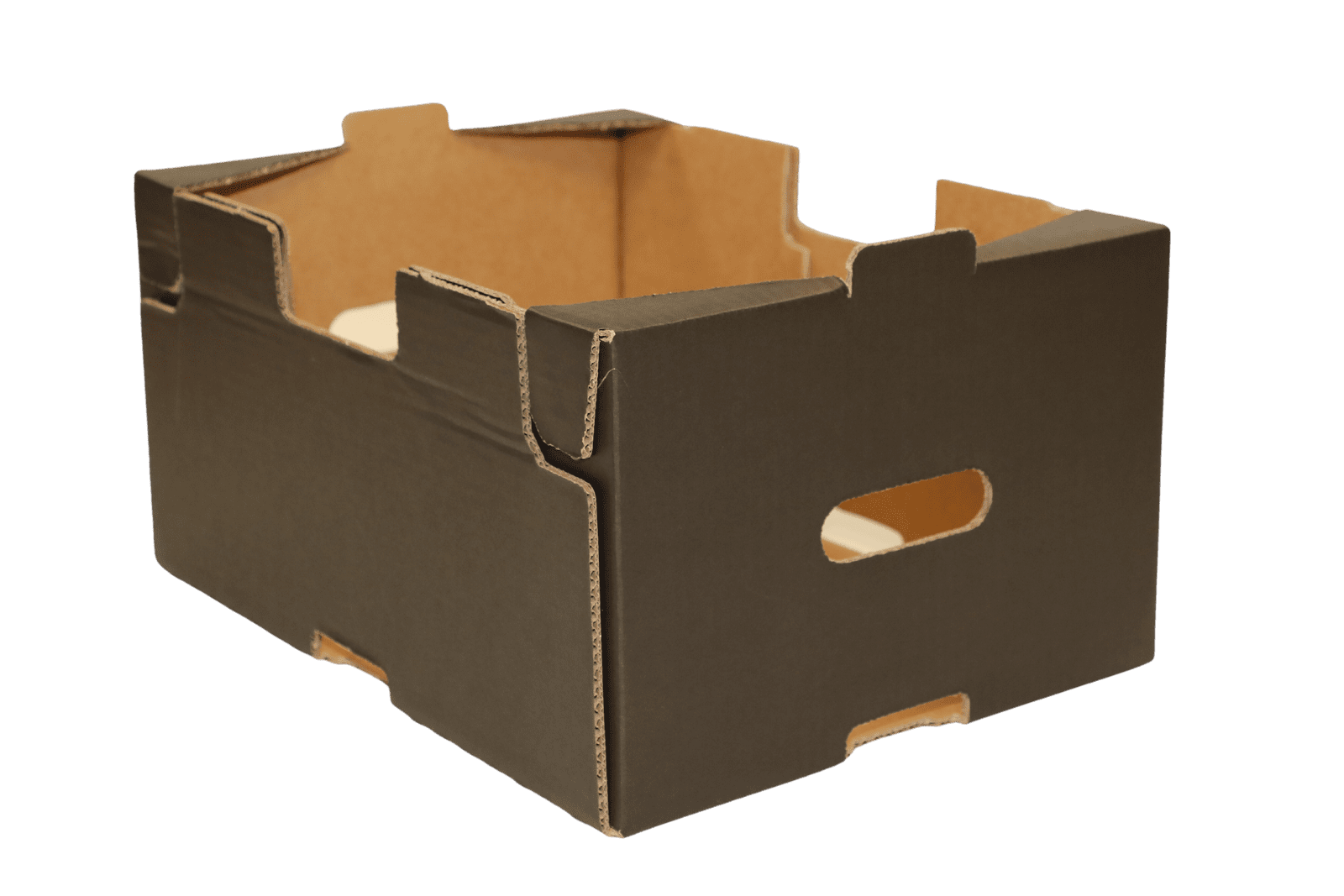
The types of paper used in Corrugated Produce Boxes manufacture
One of the key factors that define the properties of the corrugated material is the types of paper used.
Despite cardboards’ widespread use, there are 2 main types of paper that are generally used for the liners. These are known as Kraft and Test liners.
Kraft paper is manufactured from softwood trees. Due to the “virgin” fibres, it is both the easiest to print on and also the strongest type of paper. As a result, it is the most commonly used outside liner when selecting material to produce corrugated boxes and packaging.
Test paper (sometimes called Duplex Paper) is actually a double layered paper. Being recycled, Test paper is less costly than Kraft paper though it is not as strong as Kraft, or easy to print on, so is commonly used for the inside liner.
Each liner type is actually comprised of two distinct layers. A basic layer is used adhesion and strength, whilst a finer “cover” layer is used mainly for improved aesthetics and to aid printing.
Whilst Kraft and Test liners are the most popular, there are a number of other options available for outer and inner liners when manufacturing cardboard:
- KRAFT (K): Virgin Kraft paper
- TEST 2 (T2): Partly recycled liner paper
- TEST 3 (T): Fully recycled liner
- CHIP (C): Waste based liners
- FULLY BLEACHED WHITE (BW): Fully bleached Kraft liner
- WHITE TOP (WT): White coated recycled liner
- MOTTLED KRAFT (MK): Mottled white Kraft
- OYSTER (OY): Mottled test liner
Note: There are other specialist papers available
Looking For a Custom Cardboard Box
Request A Cardboard Box Quote
Contact Your Local Packaging Expert
Weight of Paper Variances
The weight of paper used in corrugated produce boxes is typically measured in grams per square meter (gsm). For corrugated boxes, common weight ranges are between 100gsm and 350gsm.
The exact weight of paper used in a corrugated produce box depends on the type of produce being transported and stored, as well as the desired level of protection and durability required.
For example, lighter weight paper such as 100gsm or 120gsm may be used for produce that is relatively lightweight and delicate, while heavier weight paper such as 220gsm or 350gsm may be used for produce that is heavier or requires additional protection during transit.
if you are using a corrugated board that has a 125 gsm Kraft paper liner, you will often see it referred to as 125K.
Common paperweights – when used for corrugated material at least, include the following:
- 115/125 GSM
- 140/150 GSM
- 185/200 GSM
- 300 GSM
The above list is not extensive, and other weights may be available.


Flute Grades Explained
Flute grade is an important aspect of corrugated cardboard packaging as it determines the thickness and strength of the corrugated layer in the box. The flute grade is defined by the height of the corrugated flutes, which are the arched or wavy structures that run between the two flat layers of paper (known as the linerboard). Different flute grades offer different levels of protection and support, and are used for various packaging applications.
Here are the main types of flute grades and their applications:
- A Flute: This is the largest flute grade and offers the greatest level of protection and support. It is commonly used for heavy products, such as electronics or large appliances, as well as for products that require a lot of cushioning. A Flute: A flute is the thickest flute grade and has a typical height of 1/8 inch to 3/16 inch.
- B Flute: B flute is a medium-sized flute grade and is typically used for lighter products, such as books, toys, and smaller appliances. It provides good protection and cushioning and is more environmentally friendly than A flute due to its lower material usage. B Flute: B flute is a medium-sized flute grade and has a typical height of 1/8 inch.
- C Flute: This is the smallest flute grade and offers the least amount of protection and cushioning. It is commonly used for products that are not easily damaged and do not require a lot of cushioning, such as paper products, envelopes, and lightweight consumer goods. C Flute: C flute is the smallest flute grade and has a typical height of 3/16 inch to 1/4 inch
- E Flute: E flute is an even smaller flute grade and is used for products that require a high level of printing quality, such as folding cartons and boxes for cosmetic products. E Flute: E flute is an even smaller flute grade and has a typical height of 1/16 inch to 3/32 inch
It’s important to note that these are rough estimates and the exact thickness of the flutes may vary depending on the manufacturer and the specific product specifications. The thickness of the flutes will impact the overall strength and durability of the corrugated box, with thicker flutes providing more protection and support.
The choice of flute grade will depend on the specific requirements of the product being packaged, including the size and weight of the product, the level of protection and cushioning required, and the desired level of printing quality.
Are you looking for pre erected produce boxes? Call us today on 01733 311867 or contact us
Looking For a Custom Cardboard Box
Request A Cardboard Box Quote
Contact Your Local Packaging Expert
Related Posts


